

16 APRIL 2026


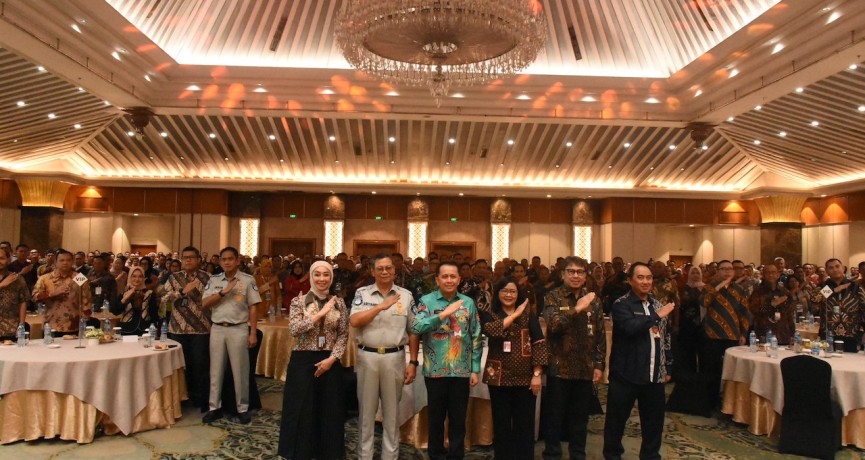
The Ministry of Home Affairs of the Republic of Indonesia (Kemendagri), through the Directorate General of Regional Financial Management (Ditjen Bina Keuangan Daerah), held a National Coordination Meeting (Rakornas) on Regional Revenue Management entitled "Acceleration, Transformation, and Implementation of Regional Tax and Retribution Collection." This event took place as a hybrid meeting from the Grand Sahid Jaya Hotel.
Attended by provincial and district/city Regional Secretaries and Heads of Regional Revenue Agencies (Bapenda) from across Indonesia, PT Penjaminan Infrastruktur Indonesia (Persero)/PT PII participated as an organizing partner and served as a resource person, along with the Ministry of Finance, the Ministry of Energy and Mineral Resources, the Supreme Audit Agency (BPK), the Ministry of Administrative and Bureaucratic Reform, PT Jasa Raharja, Bank BJB, and several other related institutions.
The Director General of Regional Financial Management at the Ministry of Home Affairs, Agus Fatoni, stated that this Rakornas serves as a strategic forum to strengthen synergy between the central and regional governments in optimizing regional revenues.
"This National Coordination Meeting aims to provide regulatory updates regarding regional revenues, update government policies, and optimize synergy between the central government and regional governments, as well as between regions," said Fatoni in his remarks.
Fatoni emphasized that amidst global dynamics and regional fiscal challenges, regional governments are required to remain creative and innovative in increasing revenues. Optimizing Regional Original Revenue (PAD) is key to strengthening regional fiscal independence and supporting sustainable development. He explained that increasing PAD can be achieved through measurable and sustainable intensification and expansion of regional revenue sources. These efforts need to be supported by improving the quality of human resources, implementing digitalization in revenue management systems, and strengthening innovation and policy breakthroughs to increase efficiency, transparency, and accountability.
According to Fatoni, the high participation of participants in this National Coordination Meeting reflects a shared commitment to increasing capacity, strengthening understanding of regulations, and strengthening collaboration and coordination between the central and regional governments.
"Strengthening regional revenues is also carried out through optimizing transfer funds by updating and improving data quality and local government performance. Various alternative financing sources are also being encouraged, including optimizing Regionally-Owned Enterprises (BUMD), Regional Public Service Agencies (BLUD), and utilizing Regionally-Owned Assets (BMD). Regional governments are also encouraged to utilize regional loan schemes, regional bonds and sukuk, Regional Government and Business Entity Cooperation (KPDBU), utilizing corporate social responsibility (CSR), optimizing the role of Baznas (National Alms Agency), and support from relevant ministries and institutions," he explained.
Meanwhile, Acting President Director of PT PII, Andre Permana, emphasized that the momentum for transforming regional revenue management needs to be accompanied by optimism from regional governments in utilizing creative financing schemes to accelerate development.
"Amidst the ever-increasing development needs, PPPs can be a game-changer for local governments to expand and improve infrastructure services for the public without relying solely on the regional budget. PT PII is ready to support local governments by providing guarantee support, sustainable risk management/mitigation, and mentoring and project preparation facilities to make projects more financially viable, attractive to investors, and able to accelerate the provision of services that directly impact the community," said Andre.
Andre added that synergy across ministries/agencies, local governments, and the private sector can be key to ensuring creative financing/PPPs become a key strategy in delivering inclusive, sustainable regional development with broad economic impact.